Note of caution to our neighbours – if you are cleaning up please be careful as the mess left is filthy and full of all sorts of germs – it stinks. Last time this happened my husband cleaned up and he ended up with D&V. This is a health hazard.
It’s obviously the monsoon period in London, with floods and hail to prove it. Is it climate change?
Certainly the enormous puddles in Fawnbrake Avenue yesterday afternoon and evening were exceptional.
You should have seen it earlier, when it covered the pavement too.
Those of us who live in the lowest lying section of the street are well accustomed to dealing with accumulations of rainwater where the surface dips between numbers 73 – 85. Rain run-off find its way here from both directions and often lingers when the grate cover is blocked by leaves, twigs and other debris. We and our neighbours have spent many happy hours with rakes and brooms dislodging the rubbish so that the water can flow away.
The last few days have been different. The obstruction in the drains is clearly more deep-seated; clearing the visible blockage hasn’t helped. Hence the biblical flooding yesterday afternoon, and general resort to Wellington boots.
We and our neighbours have reported this to Lambeth Street Care not once, not twice but… well, we’re losing count now. This morning we alerted our Counsellor Jim Dickson, who hastened to put the pressure on. We hope that something radical will be done before the next watery onslaught. Someone sent a poor street cleaner to brush up rubbish early this morning, but that won’t have solved the underlying problem.
In the meantime none of us would take it personally if, when approaching this part of the street, you cross over to the other side.
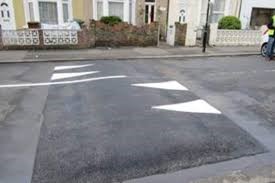
Lambeth are proposing to place full-scale speed humps on Milkwood Road in the hope of lowering the traffic speeds that make the road dangerous. They invite comments via this link.
It’s difficult to imagine any local resident objecting to this measure. Many of us have stared, astonished, at cars, vans and motorbikes roaring down Milkwood in speeds clearly in excess of the 20 MPH limit.
But maybe we shall need to monitor whether such a measure, if introduced (supposedly in August), displaces fast traffic onto Fawnbrake Avenue.
We might take them for granted. But our rich collection of trees, softening the long regularity of the brick facades, and punctuating the gentle curve and dip of the street, have been a much loved but sometimes neglected ornament of Fawnbrake Avenue for generations. They have helped to make our street an attractive part of Herne Hill to live in and visit.
Trees don’t live for ever, though. Recent years have brought changes. Some older and unsuitable trees have been removed and not replaced. Others have been replaced with specimens inappropriate to the location. One or two junior specimens, recently planted, have not survived. There are still unsightly gaps. And a street isn’t a forest, of course. Human care is needed.
Four years ago some neighbours decided to do something about this. They conducted a survey which established that some 24 trees were missing in Fawnbrake Avenue, including some empty tree pits, along with some quite unsuitable seaside-loving Tamarix shrubs (near numbers 90 – 100).
So David Williams and Laurence Marsh started a conversation with Lambeth Council’s tree officer. At that time – and probably more so, now – Lambeth’s budget pressures did not allow them a generous tree planting programme.
But they offered three trees to start with and, more significantly, said that if the residents could raise funds for more trees, Lambeth would match the same number.
The appeal for funds – generosity of Fawnbrake residents
David and Laurence put out a call for donations in 2015 and this resulted in a fabulous £8,550 gifted by neighbours, which was handed over to Lambeth Council in spring 2016. This was enough money to plant what, in the end, turned out to be a total of 40 trees. This was many more than was initially hoped for and allowed further gaps to be filled. Around half of all households in the road contributed with donations ranging from the modest to the exceedingly generous.
A variety of species was planted, all substantially smaller than the tall, older trees which had dominated our street and tended to damage pavements and adjoining properties. And all were chosen for their attractive blossom, flowers or foliage. The average cost of each tree was £450.
Most of the new and replacement trees were planted in 2016. Lambeth’s tree officer advised, and our tree guardians also warned, that once planted, and for the first year or two, young trees do need to be adopted by nearby residents to keep them thoroughly watered.
Oops! Where did our tree go?
Two trees did die, but all the rest have done well, although very recently – and inexplicably – one of the new trees, planted outside Nos.98/100, simply vanished. (Does anyone know why or how?)
More new trees on the way
Cleverly, our tree champions spotted the opportunity – through the good offices of the Herne Hill Society – to claim Gift Aid relief for the residents’ original donation, generating a further £1,797 which can in turn fund around four more trees. On top of that, Lambeth have been persuaded to plant three new trees including a replacement for the one outside number 106 which didn’t survive. The other non-survivor (outside No.21) was replaced last year..
Protect our trees!
We will update neighbours when these new young trees are in place so that people can, we hope, keep a friendly eye on them and in particular see that they are given enough water over their first summer. And if the soil in the tree pit seems suitable, neighbours can of course plant some seeds and flowers, adding to the gaiety of the street.
Lambeth tree officers strongly advise that young trees should be thoroughly watered every few days from April – September – not just the newly planted ones but all young trees for the first 3 years, more if it’s particularly dry.
All our trees, old and new, suffer an additional risk from high sided or carelessly driven trucks and vans which can either push a tree away from its roots or break off branches. If anyone sees this happening, please advise the drivers to be careful when parking or delivering, since the trees are ours, not the councils and that we paid £450 for our tree!
London, the world’s largest urban forest
‘London Is A Forest’ is the title of a new book, to be published in the next week or so. It’s written by Paul Wood, author of ‘London’s Street Trees: a Field Guide to the Urban Forest’, the first book on the city’s frontline trees (published 2017).
As he states:
“Can a city be a forest? At first glance, this does not chime with our childhood idea of the ‘wild wood’ – a dark entanglement of trees, where humans fear to tread. But a forest does not need to be dense and impenetrable, and it’s not unheard of for people to live in them either.
In London, 8.6 million people are crammed into just 600 square miles alongside 8.3 million trees, and millions upon millions of other plants, insects and animals. According to one UN definition, this makes the city a forest. The Forestry Commission agree, describing London as the world’s largest urban forest. And it’s a very special, urban forest at that.”
Our efficient and well-organised neighbours have consulted via various clever online apps and agreed that this summer’s Fawnbrake Avenue street party is planned for Sunday 7 July.
This evening our neighbour Rachel has told us about a tradition
she and her family began 4 years ago. She wondered if more of you wanted to
know about it, so we’re very happy to share it with you.
As Rachel puts it “At
midday on 25th, we all step outside, coats on, drink in hand (coffee,
champagne, or whatever one happens to be enjoying at that moment), and have an
impromptu drinks party on the pavement.
We congregate
around number 33. It was just a few of us at the start but is gradually
expanding. People bring extended family, dogs, children. We stay about half an
hour and then all go home.”
A great idea, and beautifully
simple. So if you live on Fawnbrake and can sneak away from the cooking
schedule for a while at midday on Christmas morning, you’d be very welcome to
join Rachel and her neighbours for pavement drinks.
The Herne Hill Society is hosting an important event on the evening of Wednesday 12 December to update residents on the progress of the Remembering Herne Hill 1914–18 Project, and introducing the newly published memoirs – Grace’s Story – of a young Herne Hill lady who lived through that war and in the difficult years that followed.
Please note that the venue for this event will be the Herne Hill Baptist Church in Half Moon Lane, which is the large red brick building only five minutes’ walk from the station, just a little way beyond The Half Moon pub. No tickets are required. Timings are 7:45 – 9:15pm
Meanwhile the memorial website (see earlier post below) is live. Volunteer researchers have unearthed and filed information about over 370 casualties on the database, with hundreds more still to add. The Society has also created two online maps to indicate where our First World War casualties lived, and also where they are buried or remembered today.
Fawnbrake casualties: Lieutenant Reginald Dell
Reginald Dell is one of at least four Fawnbrake Avenue residents – more may be discovered as the research continues – who were killed during World War I. His military records cite his address as 90 Fawnbrake Avenue.
Reginald Dell was born in Wells, Somerset in 1887. But at some subsequent point he became a resident of Herne Hill. He married Hilda Fox in Wells in early 1918. Tragically, however, he was killed in May of the same year.
Hilda remained at this address for the next 9 years, when she moved to Deepdene Road.
Reginald fought in what was known as the Spring Offensive of 1918. The 20th Battalion of the Machine Gun Corps was formed in March 1918 and fought at the Battle of St. Quentin and suffered heavy casualties at the Battle of Rosieres. In April the troops were withdrawn while they waited for new drafts. However, by this time, Reginald had clearly suffered fatal wounds and died on 5 May. He is buried in the cemetery of Avesnes-sur-Helpe with the inscription “Here is some corner of a foreign field that is forever England”.
[Extract from the World War I records being assembled by the Remembering Herne Hill 1914 – 1918 Project]
The outstanding Herne Hill memorial website was formally made publicly available just this weekend.
It is a volunteer-led project telling the story of those from Herne Hill who served and died in the First World War, as well as other residents who suffered.
There is no traditional memorial to all Herne Hill’s World War I dead.
The database, which currently contains about 350 records (though more names are emerging all the time), has been compiled and edited by the Herne Hill Society with help from the students of the Charter School, North Dulwich, and other local people.
The 100th anniversary of the Armistice was commemorated at a short, well-attended and moving Armistice 2018 ceremony at Herne Hill Station on Sunday morning. Our local Councillors were present.
Colin Wight (HHS), Cllr Becca Thackray, Cllr Jim Dickson, David Statham (MD, SE Trains)
This project is Heritage Lottery funded, thanks to money raised by National Lottery players.
The website can be searched in many ways, including by name and by actual street. This has revealed at least five soldiers from our own street who were killed.
Another name, just researched and not yet entered on the dataset, is Private Thomas Evans.
Thomas Evans was 30 years old when he was called up on 10 December 1915, showing his occupation as Architect’s Assistant. The second son and youngest child of Thomas (a King’s Messenger) and Ellen Augusta Evans, he and his older brother and two older sisters were all born in the village of Cark-in-Cartmel near Morecambe Bay in Lancashire. [1911 Census] He married Eleanor Barber at St Leonard’s, Streatham, on 27 May 1916 and was listed as living at his parents’ house, 129 Fawnbrake Avenue, Herne Hill. With his battalion he was posted to France, but was killed in action on 16 September 1916 – one of many thousands killed in the heavy fighting during the Battles of the Somme in Summer/Autumn 1916.
His grave lies in the Warlencourt British Cemetery, near Bapaume in Northern France (Pas de Calais).
More names may emerge as research continues, of course.
A neighbouring family already well established on Fawnbrake Avenue are looking for more spacious accommodation: they’re at present in a ground floor flat.
They definitely want to stay in the area, ideally in Fawnbrake Avenue itself if possible. And who can blame them?
They are chain free and ready to go any time.
They would be very grateful to hear from anyone who is contemplating selling in the near future, or from anyone who hears of any properties becoming, or about to become, available.
If anyone can help, please comment in the ‘Reply’ box below and we will pass on the details.
News about Fawnbrake Avenue & neighbouring streets in Herne Hill, London



 But they offered three trees to start with and, more significantly, said that if the residents could raise funds for more trees, Lambeth would match the same number.
 As he states:


