Southwark News has just reported that a developer has been allowed to build a further 60 new homes to an already-approved housing scheme after the latest plans were given the go ahead on Tuesday evening (October 28).
The development will loom large over Milkwood Road as well as Shakespeare Road.
Developer L&G had submitted plans to Lambeth Council to build the additional homes to the east of Shakespeare Road, an existing site it had already received planning consent for in December 2021.
The development will loom high over Milkwood Road, as well as Shakespeare Road.
Lambeth planning officers said the proposals would deliver “a range of public benefits”, including a “significant” contribution towards housing and affordable housing on an affordable site.
The council’s Planning Applications Committee gave the plans the green light. The plans will see the number of homes increase on site from 218 to 278, with three of the blocks increasing by 1 storey, 2 storeys and 4 storeys respectively.
The number of ‘affordable’ homes will increase from 67 to 85, and will deliver 35per cent affordable housing overall. The affordable housing will consist of 52 social rent homes and 33 intermediate homes which will be shared ownership.
The committee heard how Block C, the tallest block in the development, had been moved slightly to avoid an existing high voltage underground electricity cable.
The site, which is located near Herne Hill and Loughborough Junction, was once home to a waste transfer station however this was demolished following a serious fire in August 2023. The site has been mostly vacant since.
During the public consultation stage, the plans received 119 responses which were made up of 5 supporting comments, 112 objections and 2 neutral comments.
The objections also included a petition signed by 29 households from Kerin House on nearby Milkwood Road.
The quarterly meeting of the Herne Hill & Loughborough Junction ward Safer Neighbourhood Panel, between local Lambeth councillors, community representatives and the local police, was held on 5 September. PC Lamin Keita and PCSO Mo Kanneh attended for the police. Local councillors Deepak Sardiwal and Paul Valentine were present.
The main item was an update by the police representatives on crime statistics and prevention in our ward over the last three months (June – August). There were no dramatic surprises but the following is a summary.
Theft & Vehicle Theft
Bicycle theft showed 13 recorded instances (up by three), the hotspots being the bicycle parking areas close to Brockwell Lido and outside Herne Hill Train Station.
Theft of and from motor vehicles showed nine occurrences, up by four.
Five shoplifting occurrences – up by five, but the police acknowledged that many instances go unreported, and unrecorded except possibly by the retailers concerned.
Theft from persons showed 28 occurrences, well down on the previous period (which had included the start of the Brockwell Park festivals). Most thefts from persons related to mobile phone snatch thefts and the recorded hotspots were in and around Brockwell Park, at bus stops, and in Ruskin Park. The police were well aware of the surge of snatch thefts in Ruskin Park but there is of course a limit to what they can do to catch the perpetrators.
Violence Against Women & Girls
This is counted as any crime where there is a female victim, though not including mobile phone snatching. It is quite high in our ward, showing 21 incidents in the reporting period – a major priority concern for the police.
Drug-trafficking and possession and Anti-Social Behaviour
Slightly down. ‘Possession’ comes from drugs found on stop and search – drug using and taking is not normally recorded. Drug dealing on a minor scale often leads to behaviour that is categorised as antisocial behaviour (ASB) and is regularly recorded in the parks, and in and around some of the residential buildings in Herne Hill, including Meath House and the two tall blocks of flats near the station, as well as Oborne Close, which is that post-war block of bungalows on Milkwood Road close to the station. The police have upped their regular patrols, including plainclothes patrols, around Herne Hill station (including Oborne Close) and around the centre of Loughborough Junction. They also maintain a frequent offender list. They are aware of some of the violent episodes that occurred in Station Square, provoked by the usual suspects.
Police numbers
The police representatives admitted to being badly stretched. PCs are being used at football matches, demonstrations and Notting Hill Carnival, impacting community policing locally. Recruitment is difficult. One of their constables has had to be moved to a different ward, and numbers generally are declining when they should be steady or even rising.
Although they did not speak to this, we know about all the work-related factors that are driving early resignations in the police: a PC at point 5 on the pay scale gets £37k for early lates and nights. A TfL train driver gets double that at £73k plus extra for weekends with no night work. The train companies like recruiting ex police.
Communications with the community
Met Engage is a new communications platform that allows individual residents to engage on a local level with the police. It is not intended to be a platform for reporting crime, but rather for recording local residents’ concerns, to shape policing in the area and give us direct access to key information and advice. We are all encouraged to sign up for it: https://www.metengage.co.uk
In addition, https://www.met.police.uk/area/your-area/ allows us to put in your postcode and find the crime statistics for our area. It’s still a bit clunky but still an improvement in communications.
The professional artist printmakers who have been working at the Halfmoon Studio on the Bath Factory Estate, behind Norwood Road, have sadly decided to close down at the end of March. They are inviting people to visit and hunt for bargains in the final days before they leave.
The rising costs of rent, services and energy have made it uneconomic to keep going in their present premises. They aren’t the first, and won’t be the last to walk away from the arches, which for generations have provided unglamorous but functional and affordable accommodation for small businesses which often operate on narrow margins. A recent visit showed several repossession notices from landlords The Arch Company ( a joint venture between Telereal Trillium and Blackstone Property Partners), who bought the UK’s huge estate of railway arches from Network Rail in 2019.
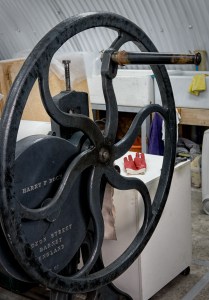
Before working in the railway arches here, and even before that in an old bakery in West Dulwich, they had rented premises behind some shops on Half Moon Lane, hence the name of the business. Their studio houses the classic instruments of printmaking, chiefly the massively heavy etching presses.
One of the printmakers, Karen Keogh, is able to move to other premises in South London.
Susie Perring will continue to operate from Artichoke Print Workshop in Loughborough Junction, and she can always be contacted via her website,
by email and by phone on 07817 762 780.
But the other artist, Sonia Rollo, is retiring from the business.
Susie and Sonia are holding a closing down sale in their studio with many bargains on offer.
Sale at the end of March
The studio will open for this sale on Monday 20 March to Sunday 26 March with many prints and etching ephemera at knockdown prices – a good opportunity to acquire some professional art for our walls. The Studio will be open from 11:30 am– 4:30 pm on those days.
To reach their Studio, you enter the Bath Factory Estate through the main gate on Norwood Road alongside the supermarket/Post Office, then head through the arch under the first railway line and walk about 100 yards to Arch 143.
Do not be dismayed by the squalid appearance of the estate: enjoy this new world!
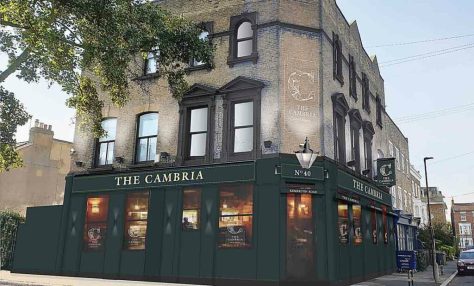
Following our report last December, it has now been announced that The Cambria will reopen next month. It has been through an extensive and expensive repair and refurbishment process since November.
It will definitely be serving meals, too: a necessary feature for most successful pubs these days.
Being so close to one of the entrances to Ruskin Park should also be an advantage to the new operators.
Although it will be run by an independent pub company, Prospect Pubs & Bars Ltd,, The Cambria is ultimately owned by the giant global beer company Heineken, which augurs well for its financial stability, we must hope.
The Cambria reborn
There was some concern locally about the pub’s application for very late opening hours, but the opening times announced seem to indicate that – after local objections – Lambeth has wisely denied permission for this: normal closing times are 11 PM , which seem appropriate for a pub in the middle of a residential area.
They have a useful website, marred only slightly by predictable gushing PR speak.
In their report, the excellent Brixton Buzz expressed regret that The Cambria is not offering a wide range of independent locally brewed beers, but concedes that this was probably unlikely since Brixton Brewery, whose products will be on regular supply, is itself now owned by Heineken.
There’s plenty of good stuff to read in the latest issue of “Herne Hill” magazine: a beautifully illustrated article about the treasures to be seen in Saint Paul’s Church; an interview with the owners of the new and already popular bubble tea shop, Cuppo Bubbo; a revealing survey of a unique 1935 house on Dorchester Drive; and a snapshot of the very cosmopolitan population of Herne Hill at the end of the 19th century and on the eve of the First World War – with an unexpected preponderance of residents of German origin. Also an affectionate review of the major exhibition at the Dulwich Picture Gallery, featuring the work of Helen Frankenthaler – a show that has been widely recognised in the national media as of major significance.
Members of the Herne Hill Society get the magazine automatically, of course. Non-members can buy it at Herne Hill Books, or can get it (along with future issues), by easily joining the Society online.
International Holocaust Memorial Day is celebrated annually on 27 January, in accordance with a decision by the UN General Assembly.
This date was chosen because on 27 January 1945, Russian forces advancing towards Germany reached the extensive Auschwitz-Birkenau concentration, labour and extermination sites in occupied Poland.
“Selection” of Hungarian Jews on the ramp at Auschwitz-II-Birkenau in German-occupied Poland, May/June 1944, during the final phase of the Holocaust. From the Auschwitz Album
They first entered Auschwitz III, the IG Farben camp at Monowitz: a soldier from the 100th Infantry Division of the Red Army entered the camp around 9 am on Saturday, 27 January 1945.
The 60th Army of the 1st Ukrainian Front (also part of the Red Army) arrived in Auschwitz I and II around 3 pm.
They found 7,000 prisoners alive in the three main camps, 500 in the other subcamps, and over 600 corpses. The rest had been dragged onto the infamous death marches, on which many were killed or expired, though some survived.
The total number of victims can never be determined precisely. 6 million is the generally accepted total of Jewish victims deliberately murdered in the Holocaust; up to 5 million others (non-Jews) is often suggested – brutally starved, deliberately worked to death, shot or gassed.
For some background to Nazi Germany’s advance towards this nightmare, see the two immediately previous posts here.
We are encouraged to put a lighted candle (if safe to do so) in in our windows on the night of 27 January.
The UK Commemorative Ceremony for HMD 2022 will be broadcast online on Thursday 27 January 2022 at 7pm. The narrator will be Sandi Toksvig OBE. We can register to join the Ceremony by clicking here.
This blog not normally a platform for non-local historical or political musings. So feel free to look away if you’re not in the mood for this – or if it becomes too painful to read. But I’m giving myself permission to make an exception, provoked by an important and partly-personal coincidence of dates.
Also, it’s in two parts, because of the length.
An infamous date – 20 January 1942
Yes, before most readers of this blog were born.
The Wannsee villa today
20 January 1942, 80 years ago this week, saw the holding of the infamous Wannsee Conference in the gracious western suburbs of Berlin. The house was a luxurious villa acquired by the Reich Security Main Office, mainly the SS, for use as a guest house and conference centre. The meeting was summoned and chaired by SS-Obergruppenführer Reinhard Heydrich.
Obergruppenführer Reinhard Heydrich
Aimed specifically at dealing expeditiously with the ‘problem’ of Europe’s Jewish communities, this highly secret meeting of senior bureaucrats was called to agree and accelerate the logistics and timing of the Holocaust – the Final Solution – in a manner sadly typical of the highly bureaucratic and efficient Nazi state. Thereafter the senior officials and state authorities attending the meeting were implicated in its decisions and consequences: there could be no turning back.
And the personal coincidence? 1942 was also the year in which I was born in wartime England (though not in that January; not in fact until October). Perhaps because I was born then, around the midpoint of World War II, but also because I lived for a short time in Berlin in the 1960s, I’ve perhaps been more preoccupied than many of my generation with the tumultuous events of that era, which of course for many people alive today is of mainly historical interest, if that.
I guess some outlines of the Holocaust are taught in UK schools, but the details are probably left to professional historians and, of course, Jewish and other groups representing and remembering those who were massacred so brutally. It would not be surprising if many people today struggled to get their heads round the scale of what happened. (Though there have of course been subsequent holocausts on a much smaller scale (Bosnia, Cambodia and some of the less blessed parts of Africa) – smaller but no less terrible.) A quick survey tells me that many people alive now, including the highly educated, haven’t heard of Wannsee at all, or only vaguely.
The point of Wannsee?
It was sometimes thought that the conference, convened on the orders of Himmler and with the approval of Hitler, instigated Nazi government plans for the Holocaust. (The term “Holocaust” is normally applied just to the killing of Europe’s 6 million Jews; but is often stretched to include other deliberate victims like gypsies. It is not normally used to encompass the millions of others, such as Russian and Polish civilians and prisoners of war who were caught up into the same process.)
But … Wannsee did not launch the systematic murder of the Jews – that policy had already been decided and the early steps had been taken.
By the end of 1941, it was already being implemented in a deliberate but only partly coordinated fashion, along with the imprisonment and ultimately killing of other unfavoured people – Poles, Gypsies, Russian military and civilians, disabled people, political opponents from within Germany, resistance workers from the occupied territories, and of course thousands of others. The Jewish community inside the Reich was already enduring savage persecution.
But the capture of Poland in late 1939, and later (in summer 1941) the invasion of Western parts of the Soviet Union, immediately placed millions more people – combatants and civilians, and particularly Jews, as well as other nationalities – under the brutal regime of the German forces, notably the SS and its murder squads. In the end, some 3 million Polish Jews – approximately 90% of Poland’s pre-war Jewry – and between 1.8 and 2.8 million ethnic Poles were killed during the German occupation of Poland.
Mass shootings in Poland, Ukraine, Russia and the Baltic states were initially the method used to eliminate Jewish and other victims, to be followed by mass displacement where the Jews transported from the West joined those in Poland, Russia and the Baltic regions. Here, “special treatment” methods could be devised and tested. The scale of the ‘problem’ now required better methods.
By late 1941, before Wannsee, some more “efficient” killing centres and methods had already been set up in occupied Poland, the Baltic states and elsewhere. The first small-scale gassings at Auschwitz took place in early September 1941, when around 850 inmates—Soviet prisoners of war and sick Polish inmates – were murdered.
The site of Chełmno today
Another infamous example was in the Western part of Poland which had been formally incorporated into the Reich. Chełmno, 30 miles northwest of Łódź, was the first of the pure extermination centres and had been set up in December 1941 in order to annihilate the inhabitants of the ghetto in that town. It was the first stationary facility where poison gas – in that case, carbon monoxide in enclosed trucks – was used for the mass murder of Jews. Other similar extermination camps that quickly followed in 1942 (Bełżec, Sobibór and Treblinka) used fixed gas chambers fed by large carbon monoxide engines. All four existed purely for the purpose of murder, chiefly of Polish Jews. They paved the way for the much bigger extermination facilities that were quickly established in mixed labour/extermination camps and their numerous satellite sites across Poland and other territories, fed by an elaborate rail transport system from all over Europe. Notably, of course, Auschwitz-Birkenau and its vast complex of industrial workshops and extermination facilities: over 1.1 million men, women and children lost their lives here. But there were many other sites.
What Wannsee did achieve for the Nazi regime, on that day 80 years ago, was that it brought together a representative group of very senior officials and military/SS officers (including one, SS-Standartenführer Dr Rudolf Lange [see below], who had personally developed the killing methods at Chełmno just a week or two earlier) to decide and impose an enhanced, ambitious and accelerated method of moving Jews out of the Reich and the occupied territories, assembling them in ghettos where necessary, and then exterminating them in large numbers in dedicated sites. The meeting also discussed different treatments for different levels of ‘Jewishness’; but any categories that were thereby spared were later included anyway, on Heydrich’s orders.
The proceedings at Wannsee were deemed particularly secret. Only a limited number of copies of the highly-redacted and deliberately vague 15-page minutes (“Protocol” in German) were typed and circulated under the authority of the secretary of the conference, SS-Obersturmbannführer (= Lieutenant-Colonel) Adolf Eichmann. All but one set of minutes were deliberately destroyed, or lost in the chaos of 1945.
But one set survived in the archives of the German Foreign Ministry and was discovered by the US occupying forces after the war.
Only then did the existence and significance of this key historical event come to light.
———————————————————————————–
In these minutes and on countless other occasions when the subject arose, orders to assemble and kill Jews were generally issued verbally, not written down. If on paper, the language was kept deliberately vague, but used well-understood phrases and hints that all would have understood.
For example, Wannsee minutes Chapter III (English translation):
“III. Another possible solution of the problem has now taken the place of emigration, i.e. the evacuation of the Jews to the East, provided that the Fuehrer gives the appropriate approval in advance.
These actions are, however, only to be considered provisional, but practical experience is already being collected which is of the greatest importance in relation to the future final solution of the Jewish question.”
Participants and later readers of the minutes will have understood “evacuation to the East” to mean deportation to labour camps and/or killing centres in occupied Poland, designated as the epicentre of the Holocaust. They will also have understood the ominous realities behind the innocuous term “practical experience”. Another circumlocution used in many documents and conversations about the same topic was “special treatment”: it simply meant systematic mass murder, usually by units of the SS.
———————————————————————————–
The Aftermath
After January 1942, as agreed at the conference, the extermination campaign gathered pace and became the “final solution”, pulling in Jews and other victims from all over the Reich and the conquered territories. It only faltered when the allies invaded Germany from both East and West and the programme collapsed in the final months of the war in 1945 as the concentration and labour camps in the East and in the Reich itself were progressively emptied – by hasty summary executions, by starvation and ill-treatment or by forced ‘death marches’ of prisoners (many directed towards Bergen-Belsen in Germany itself) which also resulted in thousands of deaths.
So there can be no doubt, once its existence had been revealed, that the Wannsee Conference opened a new and decisive chapter in the Holocaust. As one of the first great historians of this catastrophe, Professor Sir Martin Gilbert, wrote in his book “The Holocaust – the Jewish Tragedy” (1986): “What had hitherto been tentative, fragmentary and spasmodic was to become formal, comprehensive and efficient. The technical services such as the railways, the bureaucracy and the diplomats would work in harmony, towards a single goal.… By the end of January 1942, the Germans needed only to establish the apparatus of total destruction…”.
The gatehouse of Auschwitz II-Birkenau, with railway line leading to the third ramp.
The total number of victims can never be determined precisely. 6 million is the generally accepted total of Jewish victims of the Holocaust; up to 5 million others is often suggested, probably without counting the millions of Russians and Poles – civilians and prisoners of war – who were brutally starved, deliberately worked to death, shot or gassed.
Selection of Hungarian Jews at the ramp 1944
The aftermath: Heydrich &co
SS-Obergruppenführer Reinhard Heydrich, who summoned and chaired the conference on the orders of Himmler, had been head of the RSHA (the Reich Security Main Office) since 1939. A leading architect of the Final Solution, he was directly answerable to Heinrich Himmler in Himmler’s dual capacity as Chef der Deutschen Polizei (Chief of German Police) and Reichsführer-SS, the head of the Nazi Party’s Schutzstaffel (SS). Earlier, in autumn 1941, Heydrich had been appointed acting ‘Protector’ (i.e. Governor) of occupied Bohemia and Moravia, a task which he executed with deliberate brutality. Five months after the Wannsee conference and back in Prague, he was mortally wounded in an assassination attempt by UK-trained Czechoslovak resistance operatives. The Nazi reprisals in Czechoslovakia were extraordinarily savage, while Heydrich was given a state funeral in Berlin. At the end of the war, HeinrichHimmler escaped from Berlin under assumed identity but was caught by the British forces in northern Germany and committed suicide.
And RudolfLange, the most junior official at the Wannsee gathering? From occupied Poland he went on to Riga to supervise mass killings in Latvia. By the end of the war he had been promoted to SS-Standartenführer (colonel) and, back in Poland, was head of the SD in Poznań, shortly to be captured by the oncoming Russian forces. His fate is unknown, but he probably died during the conflict or committed suicide. After the Conference, AdolfEichmann and his staff became responsible for Jewish deportations to extermination camps, including the deportation of most of Hungary’s Jews. When the war ended he eluded capture and escaped to Argentina, whence he was abducted by the Israelis in 1960 and ultimately, after a long trial, hanged.
And today the villa in West Berlin, Am Großen Wannsee 56–58, after some prevarication by the German authorities, is a Holocaust commemoration centre.
There have been one or two films about the conference of which probably the best is “Conspiracy” (2001), written and directed by Frank Pierson and featuring Kenneth Branagh as Heydrich, Colin Firth as Dr Wilhelm Stuckart (Interior Ministry legal counsel) and Stanley Tucci as Eichmann. The dialogue in the film is of course invented, as the minutes of the meeting were deliberately not verbatim or, for the most part, attributed to particular speakers. But it sort of rings true.
Postscript
This note is of course only a non-specialist’s attempt to pick out some key points and consequences of this extraordinary moment in European history. The Holocaust, and the significance of this Wannsee meeting within that narrative, have been researched, examined, debated and interpreted in recent decades by probably hundreds of professional and conscientious historians – British, American, French, German and Jewish and of course others.
The Final Solution, and the parallel killing of millions of non-Jewish people, was the greatest human catastrophe: to grasp the historical facts, let alone sum up in a few lines, is almost impossible. But this is hopefully a useful reminder of something that can never be forgotten or ignored.
Holocaust Memorial Day: 27 January
in accordance with a decision by the UN General Assembly, International Holocaust Remembrance Day is celebrated annually on 27 January.
This date was chosen because on 27 January 1945 Russian forces reached the extensive Auschwitz-Birkenau concentration, labour and extermination sites. They first entered Auschwitz III, the IG Farben camp at Monowitz: a soldier from the 100th Infantry Division of the Red Army entered the camp around 9 am on Saturday, 27 January 1945. The 60th Army of the 1st Ukrainian Front (also part of the Red Army) arrived in Auschwitz I and II around 3 pm. They found 7,000 prisoners alive in the three main camps, 500 in the other subcamps, and over 600 corpses. The rest had been dragged onto the infamous death marches, from which some survived.
We are encouraged to put a lighted candle (if safe to do so) in in our windows on the night of 27 January.
The UK Commemorative Ceremony for HMD 2022 will be broadcast online on Thursday 27 January 2022 at 7pm. The narrator will be Sandi Toksvig OBE. We can watch the Ceremony by clicking here.
Some much-needed cheerful news: The Cambria pub down on the corner of Cambria Road and Kemerton Road is scheduled to reopen next spring under new and competent management.
The Cambria in December 2021
The Victorian pub closed two years ago but had been in decline for longer, lacking capital investment and experienced managers. Following repossession orders, it was acquired by Star Pubs & Bars, the pubs management wing of Amsterdam-based global beer brand Heineken.
The new owner indubitably brings a safe pair of hands and access to the sort of investment capital needed to refurbish this poor rundown institution, which might now once again offer joy, refreshment and a welcoming meeting space to the residents of this quiet and attractive corner on the cusp of Herne Hill and Loughborough Junction, as well as to those visiting Ruskin Park.
Star in turn have let the premises to experienced pub operators Prospect Pubs & Bars Ltd who will now be taking this forward, supported by the marketing, financial and technological experience of Star Pubs & Bars / Heineken.
We should expect major refurbishment and some expansion, for which Lambeth have already granted planning permission. Work on the ambitious redevelopment, including the back yard of the pub, has been entrusted to Vidette UK, specialists in pub refurbishment, and has already started.
Work has already started on the ambitious pub garden
As well as the refurbished indoor bars, the new plan offers a 40-cover garden room with retractable roof and sides, as well as indoor dining and liquid refreshments.
The core beer brands on the bar will be those supplied by the Brixton Brewery – hardly surprising, since they are now wholly owned by Heineken.
The Brixton Blog reported this news yesterday, and has obtained an cosy-looking artists’ impression what the pub might look like when the refurbishment is finished.
… is an archetypal 1930s modernist home in Dorchester Drive, which has just come on the market after 65 years.
It starts with Kemp & Tasker
Who? Leslie Kemp and Frederick Tasker were English architects who practised in the 1930s as Kemp & Tasker.
They are best known for their cinemas (many now demolished, inevitably), although they are also responsible for several notable 1930s/modernist buildings in South London and Kent, often constructed by an energetic firm of builders, the Morrell brothers of Bromley.
These include the Dorchester Court flats between Herne Hill and Dorchester Drive, which as many local people will know are now owned by a neglectful property company harbouring ambitions for deleterious extensions.
However the Morrell brothers also built individual family homes including two Kemp & Tasker designed houses just up the road from our street, on Dorchester Drive. Indeed, the Morrells designed and built that whole street, each house being different from its neighbours.
Dorchester Drive
In 1934, one particular Kemp & Tasker house design was submitted to the Daily Mail’s Ideal House Competition.
The Morrells embraced and promoted this design, claiming in a glossy brochure (unearthed for us by our learned neighbour Laurence, who indeed spotted that this distinctive house has come on the market) that it could be built to order anywhere. And so it was.
It’s red
Unlike another No 10 with a famous black door, number 10 Dorchester Drive, two streets up from here, has in fact a red door and windows and is one of the three known Kemp & Tasker examples of this design that still exist – and it is now on sale.
Morrells brochure for K&T house
Form an orderly queue
The 5-bedroomed house is said to be fundamentally in good order, having been lived in and cared for by the same family – Mr & Mrs Eysenck – since 1956. Hans Jürgen Eysenck, the celebrated and latterly controversial psychologist, died in 1997 and his wife Sybil Eysenck died in March 2020, which explains why the house is now on the market for the first time in 65 years.
The property is being marketed through estate agents Hamptons. Their blurbannounces that
“… this house now provides the opportunity for a buyer to breathe new life into a well-loved family home to create something really special in terms of style and space. It has wonderful features such as curved doors, original hardwood flooring (beneath existing carpets), original Crittall windows, the fabulous ‘sunspan’ curved window in the lounge, grand iron staircase and original tiled bathroom. There is a wraparound garden and off-street parking on both sides.”
However, the buyers will need to find £1.75 million, plus a fair bit more for the necessary updating. Insulating all those big windows will also be quite a challenge. The red paint will probably be replaced by something more muted from Farrow & Ball or Mylands.
Disappointed dreams
Incidentally, the Morrell brothers (they were twins) also built a much bigger house, for themselves, at no. 5 Dorchester Drive. But they managed to go bankrupt and never got to live there.
News about Fawnbrake Avenue & neighbouring streets in Herne Hill, London


 The rising costs of rent, services and energy have made it uneconomic to keep going in their present premises. They aren’t the first, and won’t be the last to walk away from the arches, which for generations have provided unglamorous but functional and affordable accommodation for small businesses which often operate on narrow margins. A recent visit showed several repossession notices from landlords The Arch Company ( a joint venture between Telereal Trillium and Blackstone Property Partners), who bought the UK’s huge estate of railway arches from Network Rail in 2019.